Because you shouldn’t always believe everything you read on the internet, we’ve pulled together 12 common solar energy myths we often hear to bust them and provide you with the facts.

My roof isn’t south facing,  I can’t have solar 

Wrong – yes, you can! One of the most common myths about solar is that you must have a south facing roof for it to work. This isn’t the case! Solar works from light radiance, not direct sunlight and so installed on a south, east or west facing roof the array will still generate power. Although probably a low yield, it would still provide some generation even on a north facing roof.

We only get a few days of sun in the UK, solar isn’t worth it.

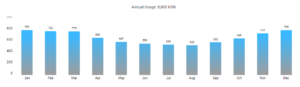
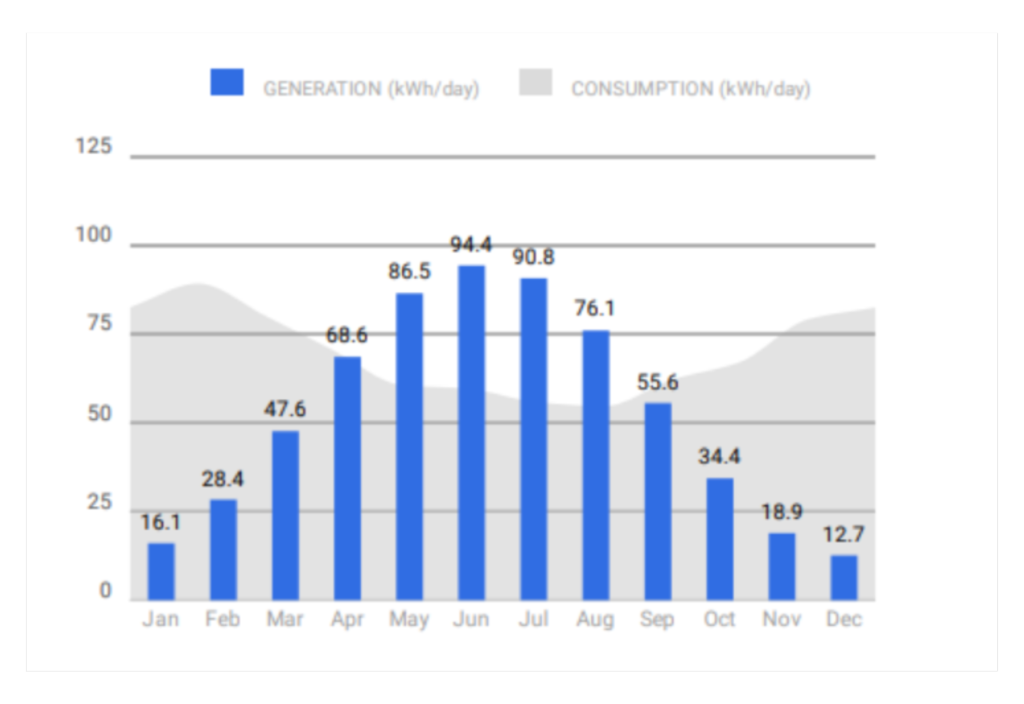
Incorrect. Similarly to the south facing myth, because direct sunshine isn’t required, even on a dull day solar will provide some generation. As you can see from the graph below, solar generation is lower in the winter but it will still produce power.
Solar costs a fortune 

Whilst the initial outlay for solar panels can be deemed pricy for some, the cost of generating your own power will outweigh the cost of purchase from the grid in the long run. The average payback for a solar array is approximately 5-8years depending on the size of array and energy usage.

A study conducted by the Office for Budget Responsibility last year estimated that levelized cost of solar generated electricity (LCOE) could be the cheapest form of power generation. Estimates for energy costs of projects to be commissioned in 2025 show the wind and solar have a LCOE unit cost of between 4 & 5 pence per kWhr with the equivalent combined gas turbine electricity costing 14.4 pence per kWhr (GOV.UK). This does need to be put into context in terms of load balancing on the network, however it is safe to say that renewable technologies including solar are significantly cheaper than other traditional methods of electricity production.

I rent my building so can’t have solar panels 

That’s not always the case. If you have a long-term lease, you may be able to obtain written consent from your landlord to install solar. This may come with a clause for removal at the end of their life or replacement however this would enable you to benefit from solar without ownership of the building. Alternatively, you could encourage your landlord to install solar on the building and arrange a power purchase agreement so that you can both benefit from the installation. 

Solar panels don’t look good!

This is a difficult one as its down to perception. If an array is installed well, it can often look attractive on a roof. Options such as in-roof are also designed to allow the array to effectively become part of the roof and so look more aesthetically pleasing.

Solar panels will damage my roof 

When designing a solar installation, the most suitable mounting equipment is selected for your roof type. During the installation process, great care is taken to ensure that there is no damage to the roof and any roofing materials that are removed are re-instated or sealed.

Where solar is mounted above standard roofing materials, they can in fact shield the roof somewhat from the elements. All of our installations come with a 5 year workmanship warranty to give you peace of mind that should you have any issues, we’re on hand to help.

Installing solar means you won’t have an electricity bill 

Unfortunately not. Whilst installation of solar will reduce your energy bills, you will still have an electricity bill for the power you consume when the solar isn’t generating. Ways to further reduce your bills include:

  • Add a suitably sized battery to allow for more of the power generated to be utilised on site.
  • Agree a smart export guarantee with your energy supplier to enable you to generate a revenue from power export back to the gird.
  • Go off-grid! Maybe an extreme option but the only way to eliminate your bill completely would be to install a system large enough to cover your demands in all eventualities.

Solar Panels don’t work 

But they do! When correctly designed and installed, solar panels work! Like with any technology, there is always some negative press and claims that they don’t work. This simply isn’t true. Solar is a proven technology which has been around for over 60 years.

If there’s a power cut, a solar array will still provide power to your building

Solar panels alone won’t enable you to have off-grid power in the event of a power cut. However, in the UK, certain battery storage manufacturers have the ability to effectively create a mini-grid in the event of a power outage, thus allowing you to be off-grid and utilise power generated on site.

Solar Panels don’t save carbon

Yes, they do! Solar panels offer a potentially huge saving of carbon emissions over their lifetime. Research has shown that the average carbon payback period for solar panels is 1-4 years. This means that over their lifetime, typically 40 years, each panel will generate zero-carbon and zero-pollution electricity for decades after any carbon emitted in its production has been paid back.

Solar technology is changing so fast, it’s not worth installing yet 

False. It’s true that solar technology is changing relatively quickly, however it’s only to be expected with the massive expansion and distribution of a successful new tech.

Solar power has already evolved to a point where it is effectively the cheapest and easiest to run technology. It would be remiss to disregard a tech that is already so efficient.

Solar Panels don’t last

They really do! Solar is one of the most reliable generation technologies.  To combat any stigma relating to performance and reliability most manufacturers offer outstanding performance warranties of 25-35yrs.  Lets face it, you could only do this if your technology was wholly reliable.

With an astonishing increase in solar installation over the past 10 years, solar speaks for itself.  Armed with these facts there has never been a better time to invest in solar, so go on, give us a call and see how solar can work for you!

Speak to our experts today on 01253 608470 or click here.

Back to all news

Other interesting news

Most commercial premises, particularly Industrial or manufacturing facilities tend to have large energy bills and large areas of roof space. Solar lends itself perfectly to this scenario.

Commercial energy costs

Utilities can be a big expense for businesses with ever changing energy tariffs. Day rates, night rates, on and off-peak tariffs and tying into long term contracts to ensure energy security. By installing commercial solar, you take control of your energy bills by generating your own power.

Reduce costs = Increase profit.

Energy usage

Whilst installation of commercial solar will provide you with a free energy source, it’s also good practice to assess how you’re currently using your power. If energy savings can be made, its less to generate/purchase from the grid.

There’s lots of small changes that make big differences such as switching to LED lighting, installing motion sensor lights and encouraging the workforce to be more environmentally conscious.

Installing commercial solar panels

The process of installing panels onto your business has 4 stages:

1 Survey & Design

An assessment of your property will establish the most suitable installation for the business’ requirements. This will assess current energy usage, available installation space and other factors surrounding solar installation.

2 Consent & Notification

Once the initial design is complete, permission is sought from the relevant parties such as planning, grid connection and where relevant, landlords.

3 Installation

Solar Installation comprises two parts, mechanical and electrical. First is the installation of the mounting frame and solar panels onto the roof. The latter being the connection to the properties electrical supply.

4 Monitoring & Maintenance

Following installation, the system can be monitored remotely to check the performance of the solar array and re-set any potential errors. Whilst solar is a virtually maintenance free technology, periodic inspection is recommended to ensure the system is operating at peak performance.

Additional benefits of commercial solar

In addition to the above, there are other benefits to be considered when installing solar PV.

  • Super-deduction and special rate first year capital allowances could offer a tax benefit on your solar installation. Your accountant will be able to advise on the ins and outs of this as the rates are business specific.
  • In showing that you are taking strides towards reducing our business’s carbon emissions, you are effectively making your product greener. Green credentials are a great way to give your business an edge on your competitors.
  • Last but not least, peace of mind. By installing commercial solar, you can be rest assured that you are providing your business with a clean, green future 💚
Back to all news

Other interesting news

Solar PV is a great addition to any home or business. By installing solar, you are harvesting the power of the sun and producing your own green electricity. Solar installation will not only reduce your carbon footprint but also reduce your energy costs.

We’ve put together a quick guide of the solar installation process from start to finish to provide you with everything you need to know.
Design
During the design stage, your property is assessed to check suitability and establish an appropriate array size. This process includes assessment of your property, power consumption, electricity supply and budget. From a desk-based assessment, we can establish how many panels can be installed, provide an estimate of the yield and an indicative cost for installation.

Business Energy Usage

When assessing a property, some of the main things we will consider are roof orientation and slope, roof type, shading and electrical connection. These are all factors that will impact the installation and ultimately the predicted yield.

Grid Connection

Where a system exceeds 3.68kW single phase or 11.04kW three phase, a G99 application must be made to the distribution network operator (DNO) to gain permission to connect. The DNO will assess your current connection and the wider network to establish if any re-enforcement works would be required to allow the solar connection.

Planning Permission

Whilst most roof mounted systems fall under permitted development, you should always check with your local planning authority if a planning application is required. Where planning isn’t required, you may wish to obtain a permitted development certificate. For ground mount solar over 9m2, planning permission will be required. More information about solar planning permission can be found on the planning portal.

Solar Installation Process

Once all design and consents are completed, the solar installation process can begin:

Access – Suitable scaffolding and netting (where required) is installed, checked and ticketed prior to installation.

Mounting – The relevant mounting system is installed to the manufactures specification.

Panels – Once the mounting frame is complete, panels are secured using solar clamps. The panels are connected into strings on the reverse of the panels as they’re installed.

solar installers

Electrical – Inverters are installed and cable strings from the panels connected.

Commission & Testing – Once all hardware is installed, the system is tested and commissioned to ensure it is working correctly.

Certification – An electrical certificate is produced along with an MCS Certificate (<50kW). The DNO is then post-notified of the installation and registered as a Small Scale Embedded Generator (SSEG).

Selling your power

Once the system is operational, excess power may be eligible for smart export guarantee (SEG) payments. The array can be registered with your energy provider or the highest bidding competitor. To register, all commissioning documents and certification will be required. These payments are often made monthly and so provide you with a revenue from your installation.

If storage is installed on site, you may be able to register for a smart tariff meaning you can sell power back to the grid during peak demand and charge your battery when rates are lower.

Monitoring

Following installation, the solar array can be monitored remotely through the inverter. These online platforms vary by manufacturer however will all provide live-data on the performance of the system.

Solar Monitoring
Solar Monitoring

Aftercare

Solar PV requires minimal maintenance following installation however periodic inspections are recommended. Considerations should be made for any future building works and pruning of any large foliage that may cause shading upon the roof.

Where the array is located in a particularly dusty area or close to trees, they should also be cleaned regularly to ensure they continue to generate at peak performance.

Conclusion

Solar has numerous benefits from the obvious saving on your electricity bill through to the green credentials you can boast to your friends and clients about. We understand that solar is an investment and that it’s important to know the full details before taking the leap.

A well designed, planned and installed system will provide you with a revenue stream for your home or business for years to come.

Our team are on hand to help you through this, step by step. Contact Us | Contractors | Thompsons Limited Blackpool

Back to all news

Other interesting news

Thompsons Solar are excited to be exhibiting at the 2024 Lancashire Net Zero Carbon Conference. The event will take place at Ribby Hall on the 26th June, hosted by Lancashire Business View.

This is a fantastic opportunity for Lancashire businesses to learn more about carbon reduction and net zero targets.

In addition to exhibiting, our Solar Manager Lucy Boulton will be speaking on an expert panel about renewables and their importance within the race to net zero. The panel will aim to highlight potential hurdles and how to overcome them on the road to solar installation. Our team will be on hand throughout the morning to answer any questions and provide advice on how to achieve your targets.

What is Net Zero?

Net zero is the point where greenhouse gases going into the atmosphere are equally balanced by the removal from the atmosphere. The UK government has committed to achieving Net Zero by 2050, have you set your target?
Whilst the idea seems quite daunting, there are many steps you can take towards net zero from simple things such as recycling waste to installation of solar PV or other on-site renewables. We hope that this conference will provide insight into how your business can work towards a greener future.

If you are interested in attending the event, tickets are available through Lancashire Business View: Net Zero Carbon Conference 2024 Tickets, Ribby Hall Village, Preston | TryBooking United Kingdom

Lancashire Net Zero Carbon Conference 2024


Back to all news

Other interesting news

A huge thank you to everyone who has worn green today to celebrate World Environment Day 🌍

Our Solar Team have shared a few tips on how to be kinder to our environment both at home and in the workplace:

Switch your web browser to Ecosia – only takes 2 minutes and can make a difference! Ecosia use advertisement and sponsors to plant trees whenever their search engine is used:

Use Ecosia on your desktop – Ecosia Help Center (helpscoutdocs.com)

Energy

  • Turn off lights when leaving the room.
  • Don’t leave electrical items on stand-by – whilst only a small amount of power, turning off rather than leaving on standby still counts.
  • Control your heating – By using radiator thermostats and reducing the temperature on your boiler, you can reduce your energy usage and your bill.

Waste

  • Reduce your food waste – plan meals where possible to reduce waste.
  • Re-use, re-purpose, recycle – Think before you throw. Can you use it again? Can you use it for another purpose? If not, can it be recycled?

  • Buy second hand – Although not everyone’s cup of tea, buying second hand gives products a longer life before landfill.
  • Shop smart – opt for the glass or cardboard packaging over plastic where possible as they’re easier to recycle.

Environment

  • Do you need to take the car? Think about walking or cycling for shorter journeys. This helps the environment as well as your wellbeing too!
  • Bee nice… bee’s pollinate crops and so are important for food production. Help them by planting bee-friendly plants or leaving a shallow bowl of water with sugar out on a hot day.
  • Be product savvy – Try opting for manufacturers who use sustainably sourced palm oil in their products. This will help the fight to save the rainforests.

Look out for this logo…

Finally…. Think before you print! Do you really need a hard copy?

Challenge yourself to make one small change to help the environment. Whether this is changing your shampoo to a brand that uses sustainably sourced palm oil or walking to Tesco rather than driving on your lunchbreak.

Small changes make a big difference.

Thompsons are proud to be a sustainable company

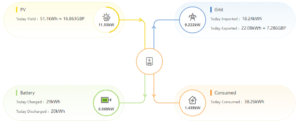
The suns out which means that Thompsons are running on 100% renewable energy just now. Today on World Environment Day, we’re actually generating more than we are using and so providing excess clean, green energy back to the grid, supporting the local network:

If you’d like to learn more about how to make your business greener, get in touch and speak with our solar team.

Back to all news

Other interesting news

Burger king Project
Prezzo project
Starbucks project
Dyson project
Gordon Ramsay project
Zizzi project
marks and spencer project
Mowgli street food project
Pho Project
Revolucion de Cuba Project
Select Service Partner project
Bar Soba project
Tap Tavern Project
The Manor project
Ramada project
Poke House Project
IWG project
flor project
The Eagle at Weeton project
da sandro project
Darwin and Wallace project
camden town brewery
columbia project
copper chimney project
byron project
bel-air project
Bonnie & Wild project
CSH-Transport project
Malmaison project
haya project
jks project
jeffersons project
las iguanas project
little creatures project
waitrose project
Moto project
Aggora project
KFC Project
Hilton Project
Sheffield FC Project
Burnley FC Project
Jollibee Project
Hampton by Hilton Project
Cineworld Cinema project
Savoy Project
Heineken Project
Bao Project
Peloton Project
euro garages project
Costa Coffee project
Timothy Oulton project
The Body Shop project
instant offices project
Revolution project
Tonkotsu Project
Dija project
Gymkhana project
Alberts Schloss project
Amway project
Ask Italian Project
Brindisa project
Buenasada project
Cabana Street food
Tim Hortons project
Welcome Break project
wagamama project
The Viking Project
temper project
steak of the art project
sakagura project
rosas project
nac project
mango bean project
Berenoak project
Gleneagles project
Blackpool FC Project
Manchester United FC Project
Hotel Du Vin & Bistro project